
Why beginners are ditching expensive prop bundles
For years, yoga retailers bundled props into pricey sets, forcing buyers to spend $200 on items they didn't need. That's changed. Teachers and studios now recommend buying one or two essential pieces first, then adding what your practice actually requires. A mat and two blocks will run you $30–$60, not $150. This shift matters because most beginners quit before they ever reach for a bolster or blanket. Research shows the first four items—mat, two blocks, strap, and optional blanket—cover 80% of all beginner practice. Buying beyond that means storing equipment you won't touch for months. The budget approach also forces you to understand each prop's real job before dropping money on it. You'll actually use what you buy, and you'll know why. That's the opposite of clearing out a closet full of unused props in two years.
Materials: foam, cork, and wood explained
Yoga block materials fall into three camps, and each trades something away. Foam blocks are lightest and cheapest—typically $8–$15 per block. They feel soft underfoot and travel easily. The trade-off: foam compresses over two to three years of regular use and eventually won't support you as firmly. They absorb sweat and need frequent washing. Cork blocks cost more ($25–$35 each) but last 10+ years without losing shape. Cork feels firmer and doesn't absorb sweat, so it's easier to keep clean. It also grips better when your hands are damp, which matters in balancing poses. Wooden blocks are heaviest and most durable but cost $40+ and feel hard under joints. For most beginners, cork delivers the best value because it lasts long enough to justify the extra upfront cost, and you won't resent using it on day one. Foam works fine if you practice only a few times per week and can afford to replace it. Blankets and straps are typically cotton, and that's nearly universal because cotton is affordable, washable, and doesn't slip. Bolsters vary: some use foam, others buckwheat hulls or recycled fibres. Buckwheat hulls mold better but weigh more; foam is lighter but compresses faster.
 14 Days Free | Mindfulness.com Meditation AppMindful and Modern · $0.00
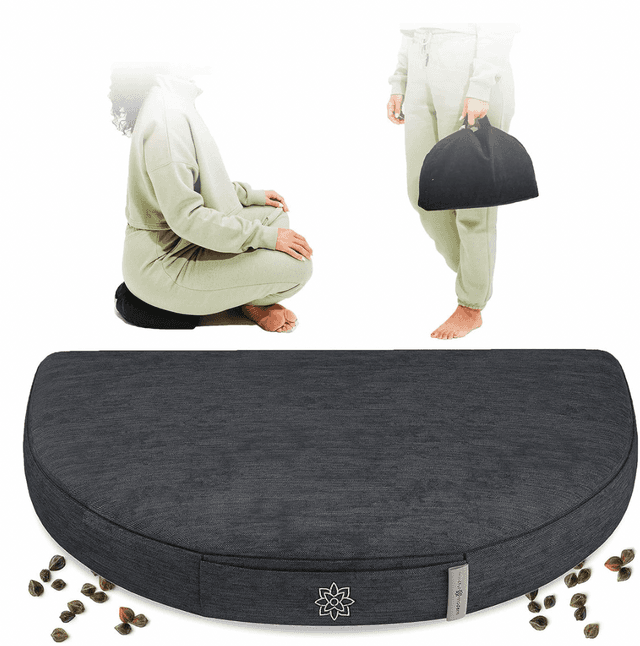 Buckwheat Travel Meditation PillowMindful and Modern · $49.99
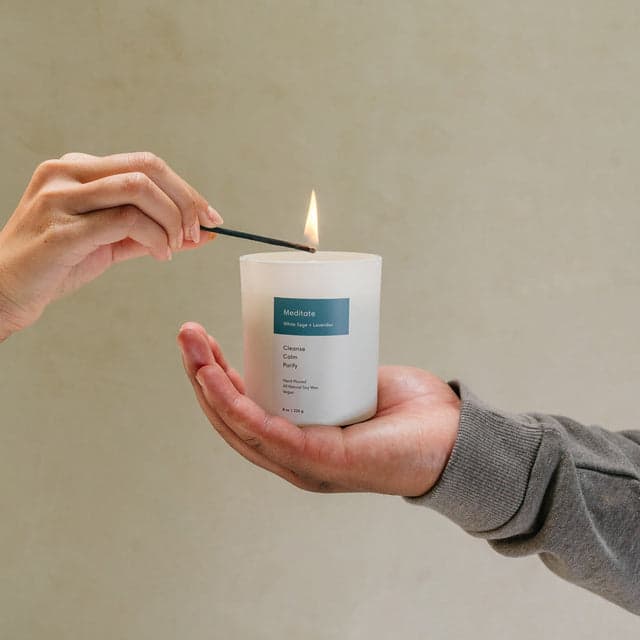 White Sage & Lavender | Meditate CandleMindful and Modern · $24.95
When you can skip a prop—and when you really can't
Many beginners feel they must buy every prop right away. The truth: you don't. Start with a mat and two blocks. A strap is the third essential purchase, around $10–$15. After that, almost everything is optional until your practice tells you it's not. You can skip a blanket for months if you have a folded towel. You can skip a bolster for years if you only practice active poses like Sun Salutations and standing sequences. Where you shouldn't cut corners: invest in blocks that won't slide on your floor, because falling off a foam block during a balance pose can hurt you. Buy a mat with enough grip to prevent your hands slipping in Downward Dog. Mats below $20 often have slippery surfaces; expect to spend $30–$50 for reliable grip. Straps with buckles beat tie-on styles because they don't slip loose mid-pose. Beyond those points, you can be honest about budget. If you can't afford a cork block, buy foam and plan to replace it in two years. If a meditation cushion costs too much right now, sit on a folded blanket or pillow. Props are aids, not requirements. The best prop is the one that gets used.
Which setup suits which buyer
A beginner doing YouTube classes at home needs only a mat, two foam blocks, and a cotton strap—that's $40–$60 total from standard retailers. Someone starting studio classes should add a bolster to their setup because studios use restorative poses, and bolsters cost $50–$80 but last years. If you're practicing yin yoga or restorative work, a bolster and blankets are non-negotiable; budget $120–$150. Someone with limited floor space might prefer Mindful and Modern meditation cushions, which serve double duty as props and as comfortable seated postures. Mindful and Modern cushions are adjustable and run $30–$80 depending on size and fill. Traveling practitioners should stick to light foam blocks and a thin mat because cork adds significant weight. Intermediate yogis who've built a home practice know exactly which props they use and can ignore everything else. Teachers and studio owners think differently: they need durable, washable props in bulk, so cork and wooden blocks make sense even at higher per-piece cost because they survive classes all day. Your buyer profile decides priority, not a checklist.
Separating long-term value from short-term price
A $12 foam block and a $28 cork block both cost money today, but only one costs money later. Foam blocks typically compress or crack within 18–24 months of heavy use; cork blocks last 10+ years. If you practice twice a week, foam might stretch to three years. If you practice daily, it won't last two. The calculation: $12 block × 2 replacements in 4 years = $24 total cost. A $28 cork block × 1 replacement in 10 years = $28. Spread over 10 years, foam and cork cost almost the same, but cork never disappoints mid-pose. Mats follow the same logic. A $25 mat with poor grip creates risk and won't last. A $50 mat with solid grip and proper thickness lasts 5 years. Bolsters show this clearly: a $50 foam bolster becomes lumpy in two years; an $80 buckwheat bolster holds its shape for a decade. The insight: cheap always looks good in the first month. Value only reveals itself over two years. For most props, spending 50% more upfront gets you 300% more lifespan. Mindful and Modern offers mats and cushions built for this calculation—their pieces are priced fairly rather than undercutting, because durability is the real value.
Sizing your props correctly on the first try
Block size matters more than most buyers realize. The standard size is 4 inches × 6 inches × 9 inches; it fits most hand sizes and provides the right height for most poses. If you have small hands or wrists, consider 3-inch-thick blocks instead. If you're practicing balancing poses, thicker blocks (5 inches) offer more stability. Try before buying if you can—pick up a block in a studio and feel how it sits under your palm in a balance pose. Strap length is usually 6 feet standard, and that covers 90% of use cases. Taller practitioners or anyone practicing with partners might want 8-foot straps, but most regret buying long straps because they're awkward to store and harder to hold securely. Bolster dimensions vary widely: round bolsters run 5–6 inches wide and 24–28 inches long; rectangular bolsters are wider (12–14 inches) and better for open chest poses. If you practice forward folds and gentle twists, round works. If you lie back in supported backbends, rectangular is easier. Blankets should be large enough to fold twice and still cover a yoga mat; that's typically 24 × 68 inches or larger. Meditation cushions come in different heights: 6–8 inches suits most seats, but anyone with tight hips should measure their usual sitting setup and choose a height that keeps their pelvis tilted forward and spine tall. Mindful and Modern cushions are adjustable, allowing you to add or remove filling until the height feels right for your body.
When seasonal sales actually save you money
Yoga prop prices drop predictably at specific times. January clearance after New Year sales cuts 30–40% off inventory; May's end-of-season sales aim for spring market shifts; September's Labor Day window offers 20–30% discounts; November's seasonal events (Singles' Day, cyber sales) stack discounts 40–50% deep. The most realistic expectation: expect 20–30% off standard-priced items during major sales, with bigger cuts (50–70%) possible on discontinued styles or overstocked props. Most discount codes cover 15–25% off, not the full 70% advertised on homepage banners. Real savings accumulate when you buy during a sale and pick items already on clearance. A $30 foam block 40% off costs $18. A bolster normally $80, marked down 30% to $56, then a 20% code applied to clearance saves another $11, bringing it to $45. That's worth timing. Where most buyers go wrong: they assume every sale is equal. A 20% summer flash sale on in-stock props is useful. A 50% off email offer requiring code entry and a $50 minimum purchase isn't, unless you truly need multiple pieces. Subscribe to newsletters from brands you like if you know you'll buy; skip aggressive limited-time offers designed to create urgency rather than actual savings.
Comparing props when specs look identical
Two cork blocks marketed as 4×6×9 can deliver completely different experiences. Thickness of cork layer matters: some blocks use 1-inch cork veneer over wood. Others are solid cork throughout. Solid cork blocks resist compression far better but cost 15–20% more. Density also differs: low-density cork compresses slightly; high-density cork feels rigid immediately. There's no universal rating, so hold blocks side-by-side if buying in person and press firmly—if it deforms noticeably, it's lower density. Straps confuse buyers because specifications (6 feet long, 1.5 inches wide, cotton) sound identical across brands, but buckle quality varies drastically. A cheap D-ring strap tightens unevenly and slips. A strap with adjustable stitching and a reinforced buckle costs $15 instead of $8 but stays put during practice. Mats are nearly impossible to compare by spec alone. Two 5mm mats can feel entirely different—one might be dense and stable, the other spongy and bouncy. Density isn't always listed; if it's not, you can't compare accurately without testing both. Bolsters filled with buckwheat hulls feel different from foam-filled ones because buckwheat molds to your body; foam stays uniform. If the description doesn't specify fill type and density, send an email or call before buying. Blankets are straightforward—cotton weight and dimensions are the whole story—but some are single-layer and thin while others are woven tightly and substantial. A heavier blanket (12–15 ounces) folds better and provides more support; lighter blankets (8–10 ounces) are easier to travel with. Read reviews mentioning feel and weight, not just star ratings.
The top mistakes that waste money and risk injury
The biggest mistake is buying props without understanding their job. A bolster isn't decoration—it serves poses you'll use in restorative or yin sessions. If you practice only active yoga, buying a bolster wastes $60+. The second mistake is avoiding blocks because you think they're for people who can't do the "real" pose. Blocks aren't cheating. They're tools that keep your spine safe in forward folds, your wrists protected in balance poses, and your hips properly tilted in seated positions. Skipping them means practicing with poor alignment, accumulating micro-injuries over months. The third mistake is buying the cheapest option without checking lifespan. A $10 foam block that becomes unusable in 18 months costs more per year than a $25 cork block lasting eight years. Fourth mistake: choosing blocks by color or aesthetic instead of material. You'll reach for a block that works well, not one that looks good in the corner. Fifth mistake: assuming your current prop pile is complete. Your practice grows. As you build strength, you'll find new uses for props. Buying two extra blocks or a strap when you discover a favorite pose prevents last-minute purchases at retail price. Sixth mistake: not testing props for slip. Try a block on your mat in a balance pose. If it slides, switch materials or surfaces. A sliding block in Warrior 3 is a fall waiting to happen. The seventh and final mistake: buying meditation cushions before you've sat in one for a week. Cushion height feels perfect in the shop and wrong after three sessions at home. Borrow a friend's cushion or rent one before committing. Many yoga studios and shops offer rentals specifically for this reason.
Our top picks

Mindful and Modern50% off
Sells durable mats and adjustable meditation cushions designed for beginners. Their cushions feature buckwheat fill and removable cotton covers, supporting proper alignment at affordable entry-level prices.
Shop Mindful and Modern →15 Mindful and Modern coupons →Frequently asked questions
Do I need all these props to start yoga?
No. Begin with a mat and two blocks. Add a strap if budget allows, then bolsters and blankets later. A complete beginner setup costs $30–$60. Studios provide extras if you attend classes. Buy as your practice reveals what you need.
Which prop material lasts longest and justifies the cost?
Cork blocks last 10+ years and cost $25–$35 per block. Foam ($10–$15) lasts 18–24 months of regular use. Over time, cork's durability offsets higher initial cost. Wooden props outlast cork but weigh more and cost significantly more.
How much should I budget for a complete beginner setup?
Aim for $40–$150 depending on choices. Budget option: $40–$60 for mat, two foam blocks, strap, and a towel. Mid-range: $80–$120 adding a cork block and cotton blanket. Premium beginner: $120–$150 with cork blocks, quality strap, and bolster.
- https://www.yogajournal.com/lifestyle/best-yoga-mats-guide/
- https://jerilynfrisbie.com/best-yoga-props-for-beginners-a-teachers-starter-kit/
- https://asivanayoga.com/blogs/yoga-blog/what-yoga-props-do-beginners-need
- https://www.huggermugger.com/blogs/yoga-gear/where-to-get-cheap-yoga-mats
- https://mingyogamat.com/cork-vs-foam-yoga-block/
- https://yogalith.com/yoga-shop-guide/